
Three materials, and the time they ask for.
Every piece is built from the same small palette. Choosing the material is half the work; the other half is waiting for it to be ready.
Metal plating
both a science and an art
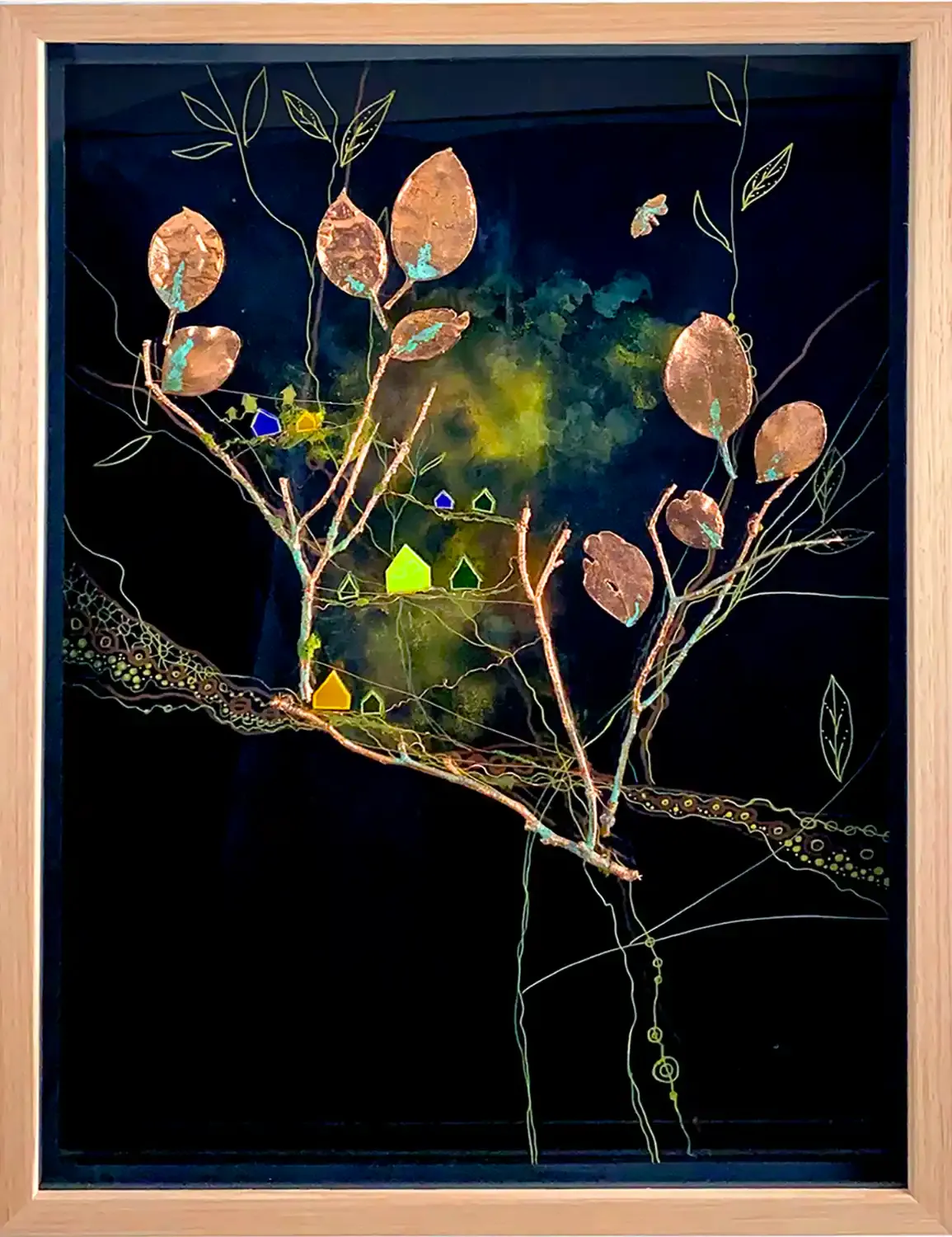
Each organic find — a leaf, a seed pod, a piece of bark — is suspended in a copper solution and held under a slow electrical current. Over hours, metal builds in layers and bonds to the surface, preserving the object in copper while keeping every line of its original shape.
Hand-cut glass
salvaged from old shopfronts and frames
Sheet glass, scored by hand and broken along the line. Edges are deliberately not ground. Where light meets the imperfect cut you get a tiny prism — a flaw I think of as a signature, the way a hand-set type page is signed by its slight uneven leading.
Ink & botanicals
eucalypt, banksia, paperbark — gathered locally
Pigment is mixed in the studio from carbon black, walnut and iron-gall. Botanicals are pressed dry between sheets of muslin for months before they ever meet the surface. The page remembers the season it came from.
I am not painting a forest. I am asking copper, glass and paper to remember one — long enough for someone to stand in front of it, in a quiet room, and recognise the weather.
A piece takes about five months.
The studio runs four pieces in parallel, each at a different stage, so the slow work of one is the quick work of another. This is what a single piece looks like, from walk to wall.
- 01
Walk and gather
Most pieces start with a walk — usually the same handful of tracks in the Wombat State Forest or along the Yarra. I take rubbings, fallen leaves, sometimes a single piece of bark. Nothing is collected from a living tree.
I keep a notebook in monospace, dated; entries go straight into the studio wall. By the time the page is full, I usually know what the piece wants to be.
- 02
Oxidise & press
Copper plates go into the bath. Botanicals go between muslin and weights. This is the patient phase, where almost nothing visible happens — but everything that comes after depends on it. I check the bath every other day; that is the studio rhythm.
- 03
Score, cut, score again
The composition is laid out at full scale on a draughting table — never digital. I score, cut, set aside, and re-score the next day with fresh eyes. I throw out about a third of what I cut. That is part of the price.
- 04
Assemble & sign
Pieces are joined with copper wire, archival adhesive, and where structure permits, a single hand-set rivet. Ink and botanicals go on last. The work is signed in graphite on the back, dated, and given a catalogue number.
The certificate of authenticity is hand-written the same day. The work and its certificate are never separated.
The forest is the first draft.
I grew up on the dry edge of the Wombat State Forest — the kind of bush that smells of eucalyptus oil at noon and wet bark at dusk. The light there is not the romantic gold of a coastal landscape; it is silver, and it falls in long strips between the trees.
That light is the colour temperature I am chasing in the work. Copper, when it oxidises slowly, finds its way to almost the same range — silver-green at the edges, soft rust in the middle, bone where the sun has bleached it.
When a piece feels finished, it usually means the room it is standing in has begun to smell, very faintly, of the forest. That has happened twice. I am still chasing the third time.
The studio makes roughly twelve pieces a year. There is no way to make more without making them less.